Flecking Performance Practice (FPP)
DESCRIPTION
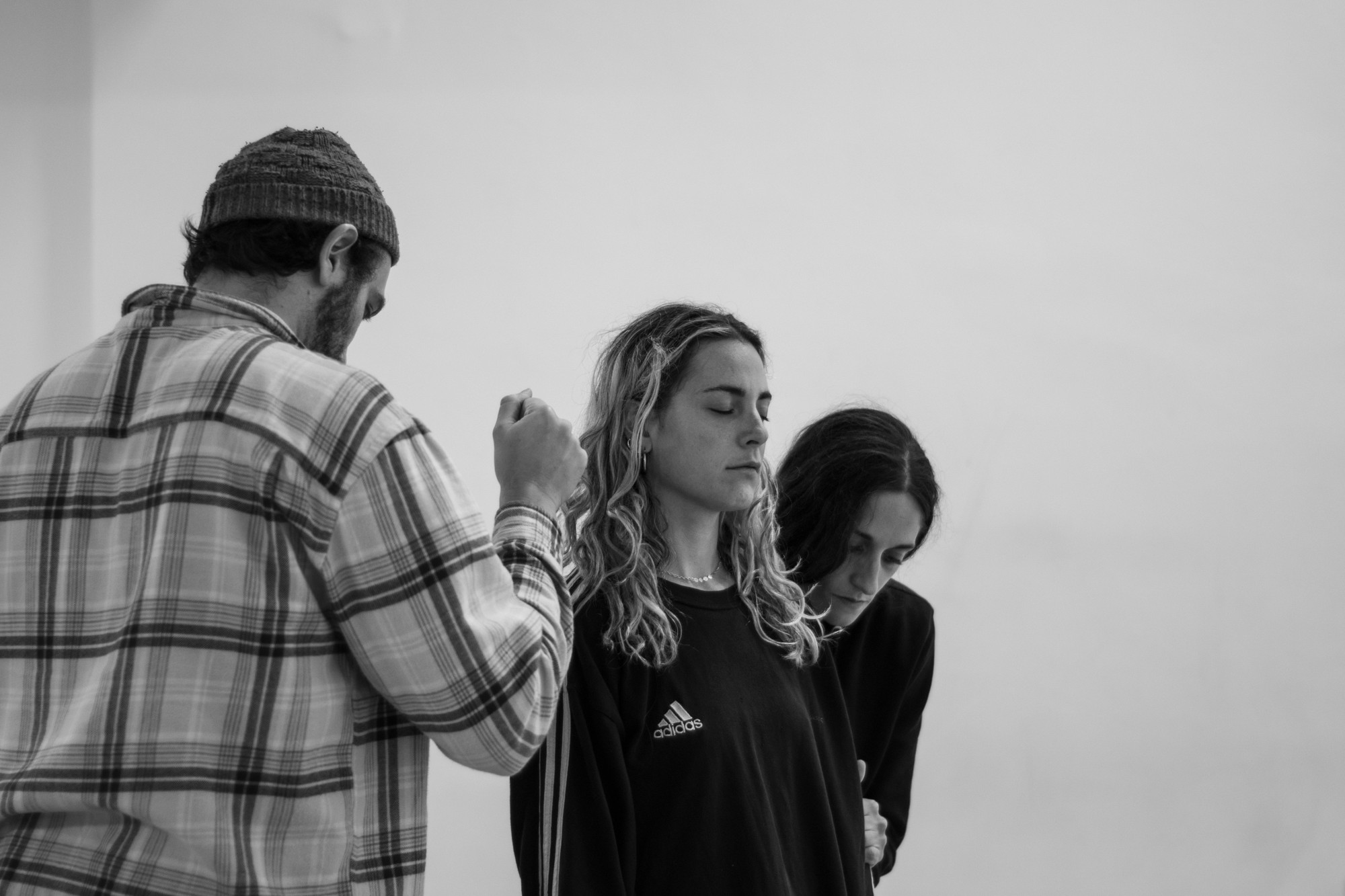
Flecking Performance Practice (FPP) is a neurodivergent-affirmative movement and performance research method developed and led by Attila Andrasi. Grounded in somatic and informed by practice-as-research, it approaches technique as a way of tuning perception—so that subtle shifts in attention, rhythm, impulse, and sensation become composable choreographic material.
Where it was developed
Flecking has been developed through Attila’s ongoing teaching and laboratory formats, and through the research tools emerging alongside Attila’s recent solo works, including Rainbow and Breeze. One key entry point is the Perceptive Ball—a kinaesthetic object practice used as an imaginative visualisation: by following weight, texture, rolling motion, and the shift of an “internal gaze,” participants generate an inner spatial image that softens thought into sensing. This object-based attention practice feeds directly into Flecking’s scores and documentation methods, offering a concrete way to access minor gesture through touch, rhythm, and non-voluntary attention.
PhD context
The method also sits explicitly within Attila’s practice-based PhD at the University of the Arts London, where minor gesture is researched as a mode of appearance within neurodivergent-informed performance practice. In this context, Flecking operates as a transferable methodology: a way of holding attention, working with impulsivity, and composing non-linear focus across studio, teaching, and performance-making.
Theoretical grounding
The method is situated within the field of minor gesture: drawing on Erin Manning’s proposition that the “minor” is not small or secondary but a shift in tendency—an emergent turning that can reorient a whole situation. In this sense, Flecking attends to what is usually overlooked (micro-variations, hesitations, changes in tone, re-directions of focus), treating these as events of becoming rather than errors to be corrected. In dialogue with Deleuze and Guattari’s notion of “minor” practices—where experimentation can deterritorialize dominant forms from within—Flecking works to loosen fixed hierarchies of technique and legibility, making space for difference to operate as generative force.
What participants do
Participants develop an agile creative body through breath, weight, timing, and coordination—finding clarity and pleasure, taking risks without collapsing, and making choices in relation to space, others, and the more-than-human. Rhythm is a primary tool: phrasing scores, timing shifts, tapping patterns, and repetition-with-variation reorganize attention and reveal the body’s natural organization, so accuracy can emerge without losing agency.
How sessions are structured
Classes move between somatic preparation, technique-as-attention, and score-based improvisation and composition, developing from simple tasks into complex real-time decision making. Tools such as imagery, sensory mapping, and compositional scores support dancers to notice micro-variation, track impulse, and work with modulation (speed, pressure, continuity) as choreographic material; brief documentation practices—writing, mapping, or spoken reflection—support integration and independent learning.
Access approach
Flecking Performance Practice is access-led: options are named clearly, self-pacing is invited, and difference is treated as information—creating multiple entry points through sensation, imagery, touch, listening, and structure. The method creates conditions for appearance, so dancers leave with practical tools for choreographic thinking and a strengthened relationship to a sensing body-mind that can travel across studio, stage, and everyday life.
STRUCTURE
Flecking Performance Practice can be hosted in several formats, scaled to the context and the group.
Standard workshop (2–5 days)
Duration: 3–4 hours per day
Participants: professional dance artists and students
Arc: somatic preparation → technique-as-attention → score-based improvisation → compositional practice and short sharings
Daily rhythm: short arrival and tuning, a small set of constraints for the day, integration through reflection (writing, mapping, or spoken notes)
Laboratory format (7–10 days)
Suitable for festivals and institutional platforms.
Purpose: deeper research time for practice-as-research and the development of shared scores
Outputs (optional): open studio, lecture-demonstration, or informal showing
Adaptation and access
Across all formats, the practice remains access-led: options are named clearly, self-pacing is invited, and tasks can be adjusted for energy, sensory needs, and experience level.
2026 Upcoming
July 6 Independent Dance (London, United Kingdom)
—
2020 - 2025
Tanzfabrik (Berlin, Germany)
ChoreoLab Europe (Arnhem, Netherlands)
Kinetic Dance Space (Athens, Greece)
Centre d’Arts en Moviment – Roca Umbert (Granollers, Spain)
Cairo Contemporary Dance School (Cairo, Egypt)
Pro Dance Oxford (Oxford)